
The Dark Fanny
Is Fanny Price the villainess of Mansfield Park?

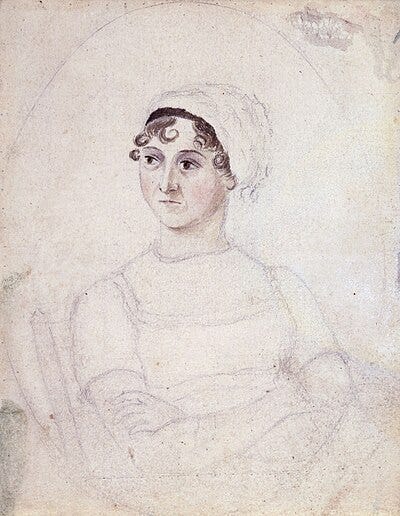
Fanny Price is undoubtedly the least favourite heroine of Jane Austen’s novels, and this has dragged down the popularity of the book, surely Austen’s masterpiece. Price is criticised as, prim, lacking in the spark and courage of Austen’s other heroines
There is no doubt Fanny would probably be one of the characters you would least like to sit next to at a dinner party. But seeing her as weak, or ‘wet’ involves ignoring the entire working through of the plot, which surely involves the most dramatic shift in power relations of any Austen novel.
In Mansfield Park Fanny Price, a poor girl is to live with her wealthy relatives, the Bertrams. Timid, frail but morally serious, Fanny is neglected by most of the family but protected by her cousin Edmund, whom she quietly loves. The mother is friendly, but self absorbed and indolent. The father cold and distant. The Bertram daughters, Maria and Julia, are vain and spoiled; their brother Tom is spendthrift. Fanny is is tyrannised over by her aunt Mrs Norris, always determined to rub in her dependent status.
The household’s moral weaknesses become clearer when Sir Thomas Bertram leaves for his Antigua estate. The arrival of the charming Crawford siblings, Henry and Mary, disrupts Mansfield. Henry flirts with both Bertram sisters, even though Maria is engaged to the dull but rich Mr Rushworth, while Fanny’s beloved Edward is attracted to Mary Crawford, despite her worldly and cynical attitudes and disdain for the church. The young people stage a private theatrical, Lovers’ Vows, against Fanny’s instincts; a play with some themes highly transgressive for the era whose staging is disturbed by Sir Thomas’ unexpected return home. Maria marries Rushworth anyway, Julia remains unsettled, and Henry, after amusing himself with Fanny, unexpectedly proposes to her.
Fanny refuses Henry despite pressure from Sir Thomas, partly because she senses his moral shallowness, but mainly because of her love for Edmund. Sent back to her poor family home in Portsmouth to reconsider her decision, she observes from a distance the catastrophes that hit Mansfield Park, with Maria running off with Henry Crawford, and Julia eloping in turn with Mr Yates, a fellow participant in the theatricals. Tom Betram has fallen heavily into debt and living in a dissipated manner, falls seriously ill and returns to Mansfield Park with his life in danger. Meanwhile, Mary Crawford reveals her defective moral sense to Fanny but, more importantly, to Edmund by treating the scandal chiefly as a matter of management and concealment. Edmund finally sees Mary clearly, turns back to Fanny, and marries her;
At the end of the book, Fanny is ascendant, having demonstrated an iron will throughout, enduring disapproval and the exile from Mansfield Park back to the impoverished and chaotic family home. Restored, not only has she married Edmund, but, shaken by the disasters in his family, Sir Thomas Betram increasingly relies on her. Fanny’s enemy Mrs Norris is sent off to look after the disgraced Maria. Julia is forgiven her elopement but has lost her influence. Tom is chastened and somewhat reflective after his illness. Fanny even manages to import another sister to take her role looking after Lady Betram.
There are some interesting echoes here with Samuel Richardson’s epistolary novel Pamela which caused a sensation in eighteenth century London. Pamela; or, Virtue Rewarded sees Pamela Andrews, a young maidservant, resist repeated attempts by her master, Mr B, to seduce or assault her after his mother’s death; through letters to her parents she records his advances, her imprisonment, her fear and her insistence on preserving her chastity, until Mr B is morally transformed, proposes marriage, and Pamela rises from servant to gentlewoman as his wife.
The novel rapidly spurred a brilliant parody by Henry Fielding, the novel Shamela.
Shamela Andrews, a servant girl, pretends to be innocent and virtuous while deliberately trying to entrap her master, Mr Booby, into marriage. Where Richardson’s Pamela resists her master’s sexual advances and is rewarded with marriage, Fielding’s Shamela cynically uses displays of chastity, tears, fainting, and religious language as tactics to increase her bargaining power, while having an illicit affair. Mr Booby, infatuated and foolish, eventually marries her, believing her to be virtuous. The brilliance of the style is essentially to run the same story but using a different set of letters to reveal a radically different character.
It would be amusing to give Mansfield Park a similar treatment. What additions would need to be made to the plot to transform the story in the same way Fielding did with Richardson’s? Surprisingly few.
Fanny arrives as a poor relation, with the sharper powers of observation that the dependent have on the world around them. If power is her main aim, why select the rather dull younger son Edmund rather than seeking a way to Tom’s heart? Fanny will have sensed Tom’s weakness, but he nonetheless remains heir to the estate. Perhaps she has some reason to sense Tom will not be able to bear children. You could imagine Tom has a history with young women in the area. Fanny as the prim poor relation doing errands in the village for Lady Betram could run into some of the women he has had assignations with – and you could well imagine the pleasure these might take in scandalising the prim poor relation who is nonetheless an excellent listener. Why has he never made any of these pregnant. Perhaps she remembers stories at Mansfield Park of Tom having a bad attack of childhood mumps, and puts two and two together.
On the face of it, Henry Crawford’s proposal might give a cynical operator some pause for thought. Indeed, Fanny keeps him interested long enough to exploit his extremely useful patronage to secure her brother a lieutenant’s position through his contacts in the Navy. But a weak and spendthrift character is less of a catch than the ultimate heir to Mansfield Park – perhaps Fanny senses he will be hard to subdue.
Doesn’t Fanny experience a remarkable amount of luck, with the disasters overtaking her rivals and enemies? The book makes it clear how naturally people turn to Fanny and confide in her, often for the sake of having someone to complain to. Her advice in the book is always described as quietly diplomatic and full of good sense. What might she, however, have achieved with the ‘insinuating manner’ of a Mrs Clay in Persuasion? Could she use this power to help steer people to their own destruction?
Sometimes her advice might be sought and followed. At other times, she might use misdirection, apparently criticising an option in such a way to make it appear even more attractive to the headstrong characters she was dealing with. Fanny might sense that a marriage between Maria and Mr Rushworth would end disastrously, and use her conversation artlessly to keep the benefits of such a match in front of Maria, particularly his great wealth. In the meantime, warning Maria of the fascination she was exerting over Henry Crawford; hinting to Henry her fears for Maria’s marriage for the same reasons might lead both to behave even more recklessly than they would have done anyway.
Even in exile in Portsmouth, you could imagine Fanny having made allies in the servants quarters and getting her own sources of information as to what is going on, with potential routes to influence there too.
It would be amusing to have an alternative version of the book along these lines, with a ringing introduction
It is with no small reluctance, and with a sensibility much affected by the duty thus imposed upon me, that I lay before the public this amended edition of Mansfield Park. The circumstances which have rendered such an undertaking necessary are, I trust, sufficient apology for an interference which would otherwise be deemed an impertinence of the gravest order. Among the papers lately recovered from a writing-desk at Chawton — long believed empty, and only opened upon the dissolution of a collateral estate — were found upwards of forty letters, in a hand indisputably Miss Price’s own, the contents of which place that lady’s conduct at Mansfield in a light so wholly at variance with the version hitherto received, that no person of feeling could read them and afterwards permit the original narrative to stand. That Miss Austen, in composing her novel, relied very materially upon Miss Price’s own account of events — communicated, as we now perceive, with a particularity of detail and a modesty of self-portrait which were themselves the chief instruments of the deception — admits of no rational doubt; and the editor is persuaded that, had the truth been disclosed to her in life, no author would have suffered more acutely under the discovery, nor laboured more zealously to set the record right. It has therefore been thought a tribute, rather than an affront, to her memory, that the work should be reissued in a form answerable to the facts as they now appear: