
The National Security Grift
We think our spies are great - but how would we know?

In all the handwringing about the capacity of the British State, pretty much every commentator exempts one area. Aren’t our intelligence and national security institutions still Rolls Royce outfits? Even Cummings expresses admiration for the ‘deep state’. But what’s the evidence?
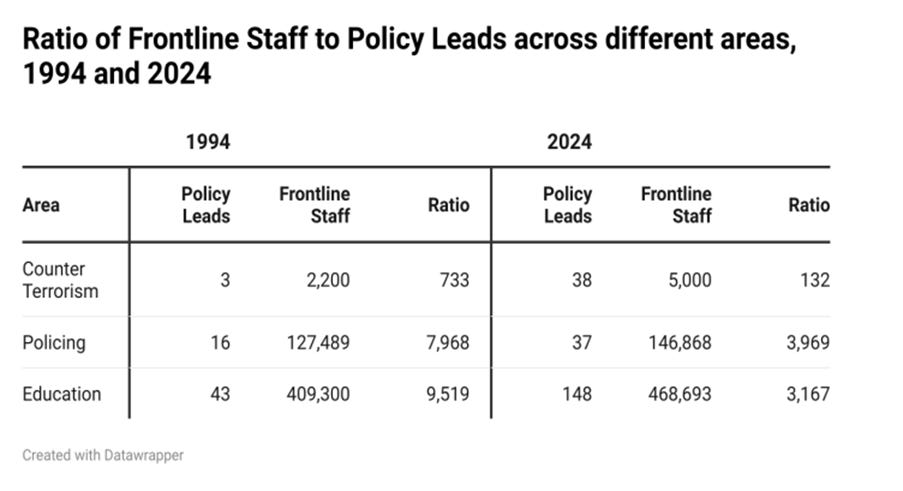
The expansion of the national security area during my career has been nothing short of breathtaking. The agencies themselves have expanded quite a lot in the post 9/11 period, having shrunk significantly when the Cold War appeared to be over. But the degree of expansion of the frontline has been dwarfed by the expansion of people in the ‘strategic centre’ dealing with national security issues (see table below).
When I arrived in the Home Office in 2002 there were 3 senior civil servants who covered the national security space. The number is now pushing 40. This has been replicated in a whole number of other departments. And on top of that has been the growth of a huge National Security Directorate in the Cabinet Office, probably past the 500 point by now.
This is headed by the grand figure of the ‘National Security Advisor’. Throughout the period of cold war turmoil, communist entryism and a major terrorist campaign on the UK mainland we managed to get by without such post. The role was invented in 2010, its very title yet another testimony to the ‘cultural cringe’ the UK shows towards everything American. Within a couple of years it was being treated as a fixed part of the constitution, to such a degree that, when it was suggested David Frost hold both this role and that of Brexit negotiator, there were howls of anguish from the national security commentariat about whether the two roles could possibly be combined.
There seems to be an inverse correlation between the scale of the challenges the UK states faces and the amount of resources put into tackling them. During WW2 the Americans were stunned (and secretly a little sheepish) at the face that the central intelligence staff in Britain constituted a few score people, compared to the thousands in Washington. Percy Craddock’s fascinating history of the Joint Intelligence Committee Know Your Enemy describes a handful of senior people thrashing out the best analysis of foreign threats available from the scanty material at their disposal. One of his most interesting points is that, in terms of raw intelligence material and information freely available in Western open societies, the Soviet system had far more facts about what was going on in the West than vice versa. Their ideological priors and the perverse incentives to tell superiors what they wanted to hear meant the Soviet leadership generally ended up getting worse analysis and making poorer decisions as a result, however. But the limited size of the British security establishment at the time seems to have contributed to clear debate and robust conclusions.
Of course one of the things about the secret world outside war time is that it is generally very hard to tell how successful our effort is. Normandy made it clear the deception effort to persuade the Germans the invasion would be in the Pas de Calais had been an enormous success. Christopher Andrew’s book reveals just how brilliantly successful MI5 had been in the war, with the entire supposed German networks in the UK being controlled by London through the ‘Double Cross’ exercise.
In 1992, Ministers’ patience with the Metropolitan Police Special Branch finally snapped, and operational lead on Irish terrorism in GB was shifted to MI5. It was obvious for all to see that the IRA were finding mainland operations increasingly difficult. When I was in the Northern Ireland Office, the first ceasefire broke. The IRA managed some spectaculars in both London and bombing the Army HQ at Thiepval Barracks in Lisburn. But network after network was rolled up in England, the campaign sputtered in Northern Ireland. Stephen Lander’s MI5 could rightly congratulate themselves on a job well done, one which helped usher the IRA towards accepting in the Good Friday Agreement a fraction of what Republicans were looking for – what the Nationalist politician John Hume teasingly called ‘Sunningdale for Slow Learners’ (after the abortive power sharing deal of 1973-4 which the IRA had rejected out of hand).
This was practical evidence of who was gaining the upper hand in a long running struggle between terrorists and the British state. What is the comparable data we have to go on today? We are frequently being told about the number of conspiracies that have been disrupted – but I used to have to monitor the number of ‘disruptions’ of organised crime groups as part of the peak ‘target mania’ of the New Labour period, and, believe me, that is a dubious metric. So is the UK notably safer than other European countries? Of European countries, Italy seems to have suffered the least? Should we be looking to see what we can learn from their intelligence structures?
In Whitehall, we hear a lot from tall and well spoken folk in the agencies about how well they are doing, and highly regarded they are among their peers. If we don’t have any direct evidence ourselves on this, where else can we go for confirmation? There is a whole group of well connected journalists who make similar reassuring noises. But of course they are being briefed by the same agreeable people, and are hardly likely to maintain access if they start demonstrating too much scepticism.
There are clear mutual preservation interests at play here. Agencies want to protect their budgets; bureaucrats their empires; commentators and security specialists their relevance. Talking up threats is a logical position for all of them.
One of the great things about the national security space for civil servants is that you can’t lose. If things are quiet, you are obviously doing a great job. If there is trouble, this only shows how vital your work is. You have the fun of knowing stuff other people don’t. And given the extraordinary number of staff in the centre, the level of personal responsibility at any grade is much lower than in other areas – but this can be glossed over in applying for jobs elsewhere by explaining there is a limited amount you can say about exactly what you were up to in your previous role. You face a fraction of the scrutiny for example major procurement exercises are largely sheltered from procurement challenge and anything other than cursory oversight by bodies like the National Audit Office.
While readers might assume civil servants working on national security are temperamentally hardline, this is very far from being the case. Indeed I know a very high flying civil servant who would not work on immigration, but was happy to make a career in the national security space. This should make the peculiarities of the Prevent counter terrorism programme and its preoccupation with right wing podcasts and Jacob Rees Mogg a bit less surprising.
Ministers similarly love the area. There is always something intoxicating about the briefings and the odd areas of operational decisions they are asked to sign off personally (it is apparently much more important that a Minister personally signs off a phone tap, while breaking in and bugging your house can be approved by a judge). Solemn words on national security always look good; like foreign policy, it is a fairly risk free area and one that enhances gravitas. While COBR (the Cabinet Office Briefing Room) was ordered to be established after various coordination fiascos in the 1970s, it has now become a word to charm with – calling a COBR meeting a performative gesture to show to the public the issue is being taken seriously.
As Britain declines in foreign influence, military power and economically, we increasingly clutch at things we think allow us to justify our place at the top table. We have become ever more obsessed with our prowess in the intelligence field, whether James Bond or the fascination in Bletchley since its secrets were first revealed in the 1970s. Similarly the SAS operation to free the hostages in the Iranian Embassy in 1980 started a romantic fascination with special operations which would have surprised our ancestors in 1900 who had found the Boer tactics distinctly unsporting. The more our hard military power declined in step with our industrial might, the greater a role these cheaper but relatable issues played in our national identity. There is a rather offputting similarity here between modern Britain and Putin’s Russia.
If readers have found some of my ideas on cutting the civil service strong meat, this is nothing to my specific proposals for this area – a 90% cut of the central policy teams would improve things enormously. Of course, this would be greeted by a wave of horror from experts, former agency chiefs and commentators.
One thing I miss more than anything among our modern politicians is the courage not to take experts too seriously. Lord Salisbury famously commented wryly in an exchange with Evelyn Baring about Army advice “I would not be too much impressed by what the soldiers tell you about the strategic importance of these places. It is their way. If they were allowed full scope, they would insist on the importance of garrisoning the Moon in order to protect us from Mars”. My personal favourite politician, Robert Peel, wrote to his successor after moving on from an Under Secretary job that involved responsibility for the secret funds “I had the charge of the Secret Service which gave me very little trouble, as I am no great advocate of sending people to the Continent to collect information which generally reaches us in the papers before it arrives from the spy”.
This is the true tone of Ministerial self confidence which we want back.
Secret service is one of the few areas where government indeed lacks accountability, rather than responsibility
How would we know? Only by winning or losing a war, probably a big one. State capacity is tested and forged in war, and neglected in peace. Is there another way?